
Amy Sprague
July 20, 2026
With the FDA's acceptance of the first commercial food process based on his microwave sterilization method, ISE Chair Juming Tang is showing how much of the advance lies in the system that surrounds the method.
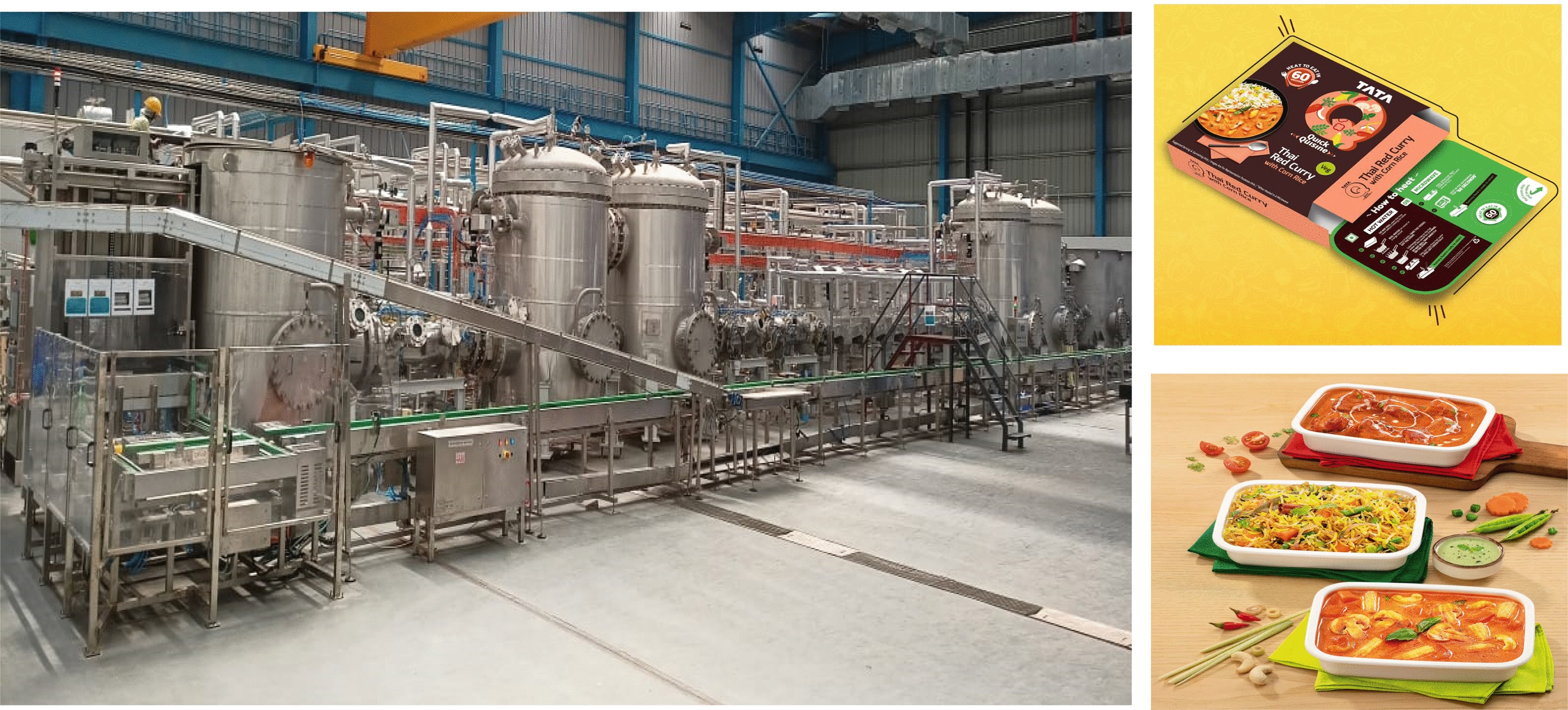
Commercial microwave system in a Tata affiliated food processing plant (left, source: 915 Labs) and shelf-stable meals produced by the company (right).
A fish filet can now sit in a pantry for three years, no refrigerator required, and still come out of its tray firm, pink and ready to eat. Earlier this year, the FDA accepted the first commercial process using the microwave sterilization technology that Juming Tang invented, a milestone decades in the making.
Tang, ISE's Frank Jungers Endowed Chair, has spent his career replacing the century-old canning process with precisely tuned microwaves. Ed Kromer's earlier profile, "Immaculate consumption," told that story. The recent acceptance is proof the method works at commercial scale. But Tang says the real achievement is the system around it.
What just cleared the FDA
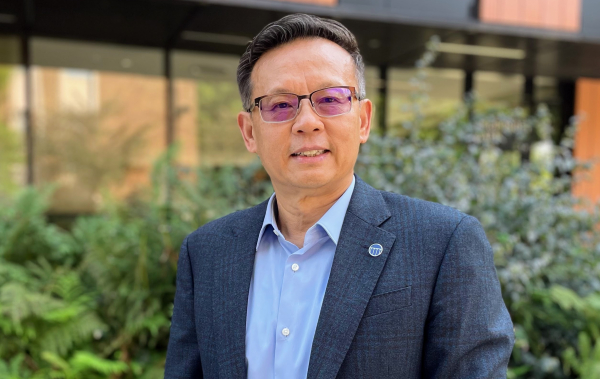
ISE Professor and Chair Juming Tang
The road to acceptance was a long one. Tang started the research in his lab in 2001, backed by the Department of Defense's Dual-Use Science and Technology program through the U.S. Army Natick Soldier Systems Center. The goal was a way to make shelf-stable meals, military MREs among them, without the century-old canning process.
To get there, Tang organized two industrial consortia of major U.S. food, equipment and packaging companies. The first built a pilot-scale system that uses 915 MHz microwaves. The second focused on winning regulatory acceptance, since in the U.S. every new shelf-stable process has to clear the FDA on its own.
The first filing, in 2007, was for mashed potatoes, which Tang chose as a simple, even test case for the science. "Mashed potato is a very homogenous material," he says. (It was also a request from Kraft, one of the consortium partners.) The filing rested on computer simulation, pilot-scale testing and microbial validation, the scientific foundation for treating pre-packaged food with microwaves. FDA scientists spent two years reviewing it. After several rounds of redesigning the pilot system, adding redundant sensors and tightening the validation, the FDA accepted the filing in 2009, setting the template for everything that followed.
Fish filets were accepted in 2010. A third filing, from a U.S. company the team assisted, came next. And in 2012, the USDA's Food Safety and Inspection Service issued a non-objection letter that cleared the method for broader use in packaged low-acid foods containing more than 2% poultry, egg or meat.
A meal made this way stays safe and stable at room temperature for up to three years, while keeping the taste, texture and nutrition of food that was just cooked. For a soldier carrying an MRE or a family stocking a pantry, that's a guaranteed warm, fresh meal.
Getting here took an unusual route. Tang proved the concept on a small pilot unit at Washington State University. The technology was licensed to a company called 915 Labs, which was later acquired by the Indian conglomerate Tata. Tata began commercial production in India in 2020 and now makes millions of shelf-stable meals a year for Indian and Southeast Asian markets.
Its filing is the one the FDA accepted in early 2026, which allows those products to be sold to U.S. consumers. Tang and his team are now in close talks with the U.S. Army Natick Soldier Systems Center and 915 Labs about bringing manufacturing of shelf-stable foods back to the United States.
Why a food engineer leads a systems department
Why does a food engineer chair the Department of Industrial & Systems Engineering? Tang's answer is that he was never only solving a food problem.
"I'm interested in using systems thinking to see how new technology can be integrated into a traditional industry," he says. "This system can reduce the carbon footprint, save energy and cut labor through automation across the whole supply chain rather than one step at a time."
The microwave is only one part of a much larger food system, one that today burns enormous energy to freeze, ship and refrigerate. Once a product is shelf-stable, cold storage comes out of the equation, and the savings ripple through every truck, warehouse and store along the way.
A simpler path for the next company
Getting a new process past the FDA has always been slow and expensive. Tang's team changed that for the companies that follow.
For decades, food producers tried to sterilize with microwaves and failed, defeated by the "cold spot," the random pocket of underheated food where bacteria can survive. Tang's team worked out how to control it, then built the scientific case that regulators now accept: how to find the cold spot, how to measure it, and how to prove the process kills pathogens. By teaching the FDA the underlying science, they cleared a far simpler path for the next company, one that skips the slow, plant-floor microbial testing that used to stand in the way.
Because that work is done, the next company has a far shorter route to acceptance. The U.S. Army is already testing the process, and new companies are running new trials.
The bigger system still to build
Tang's current project is bigger and more clearly a systems problem. He wants to build a network of regional processing hubs that move food from farm to table with fewer steps, fewer miles traveled and less waste.
He calls the FDA acceptance a major milestone for the technology. It's also the first proof for a much larger idea that a single tuned microwave, placed in the right system, can make the way we feed each other cleaner, cheaper and more resilient. Tang has given himself ten years to build the rest.