
Amy Sprague
July 23, 2026
When Meera Patel and Noelle So boarded a bus for a department-sponsored factory tour as part of "Introduction to Manufacturing Systems," they were just two ISE students who sat next to each other by chance. Two years later, they are co-founders of HERA, a Y Combinator-backed startup with $550,000 in pre-seed funding and a mission to modernize one of manufacturing's most time-consuming tasks.
An idea born in the classroom
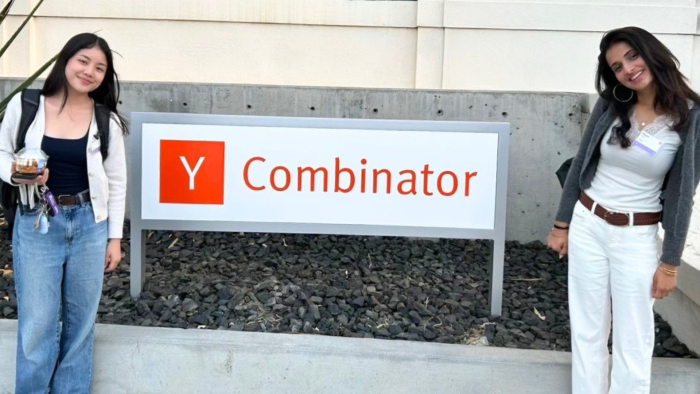
Noelle So and Meera Patel on their first day at Y Combinator.
The two became fast friends on that bus ride, bonding over strikingly similar backgrounds. Noelle grew up in the Philippines in an industrial park. Meera, from India, comes from a family where nearly everyone has worked in a factory. She says, "Following industrial engineering was just the most obvious next step. That's the only kind of life I knew."
The entrepreneurial spark came in the simulation course that follows Introduction to Manufacturing Systems, a class Meera calls one of her favorites to date, with one exception: the software, which she says "was just really, really, really old and slow." Having recently taught herself to code, she saw an opening. "While I did really like simulation, I knew that there was this opportunity where I could build better simulation software."
Meera began developing her own simulation platform, trading feedback with ISE faculty along the way. Then she put the department's professional seminar series to unconventional use. She says, "The way that I got the first person to use it was just going to the seminar, then reaching out to the speakers and cold emailing them, and asking if they'd like to see it." Those cold emails became her first user conversations. Soon there was too much momentum for one person, and she asked Noelle to join.
Listening to the data
Through dozens of customer discovery interviews, the pair learned a classic startup lesson. Noelle says, "We found out that although the clunky simulation software was a problem for us, it wasn't a problem for a lot of people." The companies doing serious simulation tended to be large, with deep pockets and decent existing tools.
But the interviews did surface a widespread pain point around mechanical design reviews. Before a part can be manufactured, engineers sit through meeting after meeting checking drawings against their company's standard operating procedures, the Machinery's Handbook, and GD&T standards. That stands for geometric dimensioning and tolerancing, or as Meera puts it, "making sure the part fits where it's supposed to fit, and that it's actually manufacturable." Mistakes that slip through this review surface later as costly rework on the factory floor. And turnover in the role is high. Noelle explains, "It's so tedious. You're not actually designing. You're just checking designs."
The pair's Hera software compresses that work into a single step: engineers upload a drawing, and the software runs those checks automatically.
ISE fundamentals, codified
While Hera uses machine learning, Meera points out that ML alone can't cut it in heavily regulated engineering environments, where probabilistic answers aren't good enough. The solution draws directly on their coursework, the physics and mechanics fundamentals every ISE student learns, translated into software.
She says, "We use ML, but we also use really basic industrial engineering fundamentals. We use discrete event simulation a lot. We write all the formulas in code, and then we run it."
When a new customer signs on, the founders start by listening. Noelle says, "We ask them what parts are most important and what kinds of checks are most important in the company. Then we'll code that ourselves so that it serves them well." Customers range from aerospace giants to local shops machining specialty parts.
And their ambitions reach well beyond design reviews. Engineering work in American manufacturing, they explain, is fragmented and expensive, which is a major barrier to the reindustrialization of the United States. Their long-term goal is a platform where a customer can upload a standard CAD file and have everything handled, from design review through production and shipping. A tool, in other words, to accelerate American manufacturing by making its most expensive tasks easier.
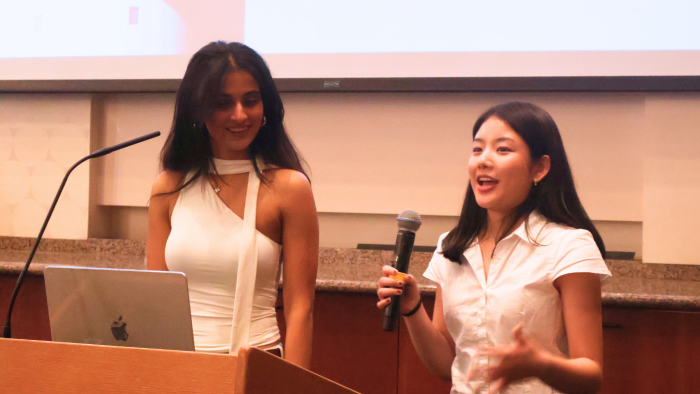
The pair presenting at Dubhacks NEXT Demo Day.
A close-knit launchpad
Both founders credit the ISE department's culture as a decisive advantage. Professor Patty Buchanan met with the pair often and made industry connections for them. Professor Shuai Huang opened doors to research opportunities in applied machine learning, which Noelle says is where the two sharpened the coding skills they now use daily.
Their path also ran through DubHacks NEXT, UW's student startup club, and the data science track within the ISE undergraduate program. After graduating in June, the pair was accepted into Y Combinator, the famed accelerator behind companies like Airbnb and DoorDash. They now live and work together in San Francisco, refining the product, increasing their sales, and still reaching out to engineers one conversation at a time.