
Amy Sprague
September 30, 2026
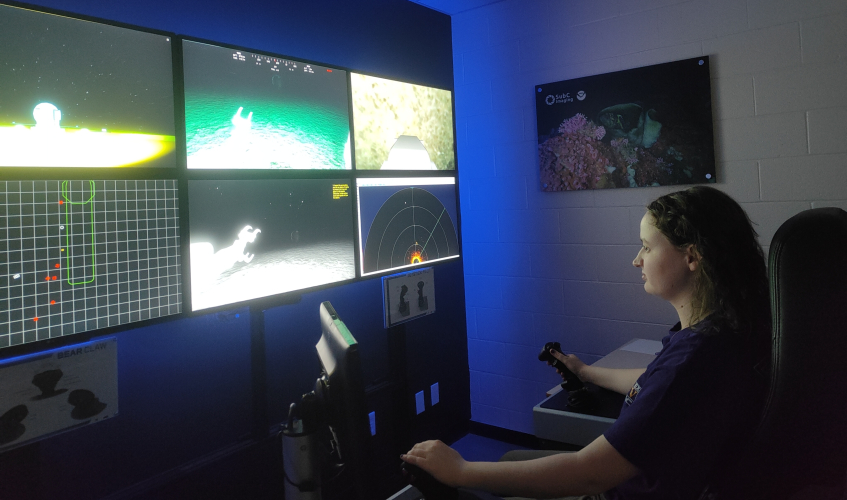
Ellen pilots an ROV deep underwater at a real ROV pilot training simulation at the Marine Institute.
ISE undergraduate Ellen Leier keeps the UW team based out of Oceanography on task.
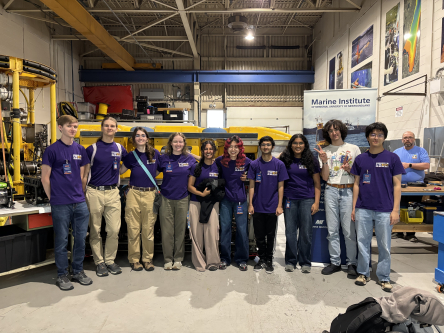
UWROV members and an alum stand in front of the team’s large yellow ROV. From left: Emmett Van Mason, Imants Smidchens, Rowan Newell, Ellen Leier, Abirami Subramanian, Suzu Yoshikawa, Arnav Jain, Krishna Maanasa Ramadugu, Sergei “Ziggy” Avetisyan and Jerry Chan.
When UW’s underwater robotics team puts its vehicle in the pool at this year’s Marine Advanced Technological Education (MATE) Remotely Operated Vehicle (ROV) World Championship in Newfoundland, the pilot won’t be allowed to look at the water. Competition rules treat the 10-foot pool as if it were 100 feet deep in the ocean, so the pilot flies the vehicle by camera alone while teammates on the deck relay what they can see from the surface.
Standing in the middle of that noise was ISE undergraduate Ellen Leier, the team’s operations lead for the runs. Their job was to watch the clock, track the score and keep everyone talking to each other.
“During our runs, I’m the one watching the clock and thinking about strategy,” they say. “If we’re running low on time, I can tell the pilot to leave a task and move on to the next one, because we need to get those points.”
The team, UWROV, finished ninth in its class, the competition’s highest division, extending a top-10 streak that goes back years. In several categories where the team traditionally does well, it came within a single point of first place. Leier, who becomes the team’s CEO this fall, called it a company record across the board.
A company, on paper
The MATE ROV competition asks student teams to act like a business. Each fall, MATE issues a request for proposals, and every team responds as a company selling its technology, making the case that its remotely operated vehicle does the job capably, affordably and safely.
The pool tasks mirror real subsea work. This year’s theme, built around Newfoundland’s harsh conditions, included collecting a coral sample, measuring a coral garden with computer vision and servicing a subsea observatory modeled on one the team visited during the trip.
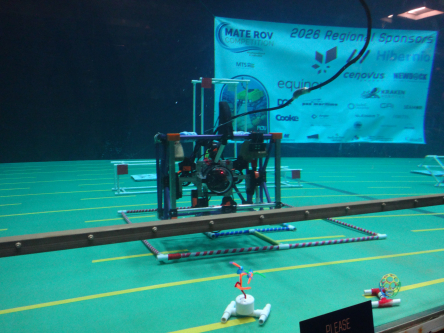
Conduit completes a task in the flume tank at the Marine Institute.
“In the pool, it’s a piece of PVC, but you treat it like the power connector you’re attaching to a subsea platform,” Leier says. “You’re creating technology that could actually be used and deployed in the real world.”
That framing rewards the whole system, not just the machine. Teams are scored on technical documentation, an engineering presentation, budgeting and accounting alongside their pool performance. UWROV has won first place in both documentation and presentation in past years, and Leier says those remain the areas where the team takes the most pride.
Finding the right seat
Leier joined UWROV in their first year at the UW after hearing about it at Engineering Launch. They’d done FIRST Robotics in high school and wanted to continue, and the idea of putting a robot in the water set this one apart from the rest.
Leier works on the team’s business operations, writing newsletter articles, updating the website and organizing outreach events. Last year they served as chief administrative officer, handling logistics and the systems side of a 42-member club. Their ISE training helps them figure out how information flows through the team, how new members learn the ropes, how nine people and a disassembled robot get to Newfoundland in carry-on luggage.
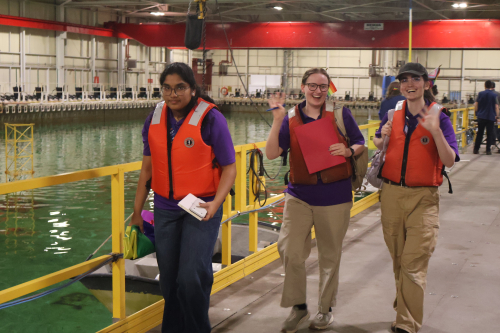
From left, Maanasa, Leier and Newell walk away from a successful product demonstration at the Engineering Basin.
“The systems way of looking at it is making sure information flows well within the team, and thinking carefully about how we introduce new members to what we do,” they say.
Their ISE coursework shows up in the shop, too. When the team moved into its own space in the Ocean Teaching Building last year, Leier applied 5S, a workplace organization method they’d practiced in class—Sort, Set in Order, Shine, Standardize, Sustain and Safety—to one section of the shop. A year later, everything in that section is still where it belongs.
This summer they’re looking at the team’s admissions process. The team scores its applicants on experience and enthusiasm, but nobody knows whether those scores predict anything. Leier will dig into several years of application data and test whether high scorers actually stayed on the team.
“We have this scoring system, but we don’t know if it’s actually telling us anything,” they say. “I want to look at the data and find out.”
A new vehicle from scratch
This season the team built a completely new ROV, and Leier says watching it come together was the best part of their year.
“Seeing the evolution of our new ROV, from a sketch over winter break to deploying in the pool, with the struggles and then triumphs, has been crazy,” they say.
The design looks different from nearly everything else at the competition. Where most teams build compact, flat vehicles with a single claw, UWROV built a PVC cube around a clear acrylic pressure hull, with rotating buoyancy arms that tilt the vehicle in the water and a gantry-mounted tool head that accepts interchangeable attachments in seconds. Last year’s vehicle was small and light enough to get pushed around by its own thrusters. This year’s design trades some agility for stability, and it’s far easier to operate.
The team also got its vertical profiling float, a device that controls its own buoyancy to rise and sink in the water column, working in competition for the first time. Team members have spent years shrinking the design into a package they call the nano float, a fraction of the size of most competitors’ versions.
UWROV sits within the School of Oceanography in the College of the Environment, mentored by Rick Rupan, who runs the Argo Float Lab and takes a deliberately hands-off approach. “When people compliment me on the ROV, I tell them I’m seeing it for the first time too,” Rupan said. “The students run this team. My job is to stay out of their way.”
Home water
Next year’s championship comes to Federal Way, a short drive from campus and a pool the team already knows from volunteering as judges for younger divisions. This year’s title went to a team from the host university, a fact Rupan pointed out to his students immediately.
Leier will lead the team there as CEO. They’re currently the only ISE student on a roster dominated by mechanical engineering and computer science majors, and they’re working on that, pitching the club to other ISE students. “It’s fun,” they say, “and there’s a seat for anyone who thinks in systems.”