
Amy Sprague
November 23, 2026
ISE master’s student Elizabeth “Thea” Higgins has taken her industrial engineering training from a Harborview research study to an award-winning capstone to a robotics team at Meta.
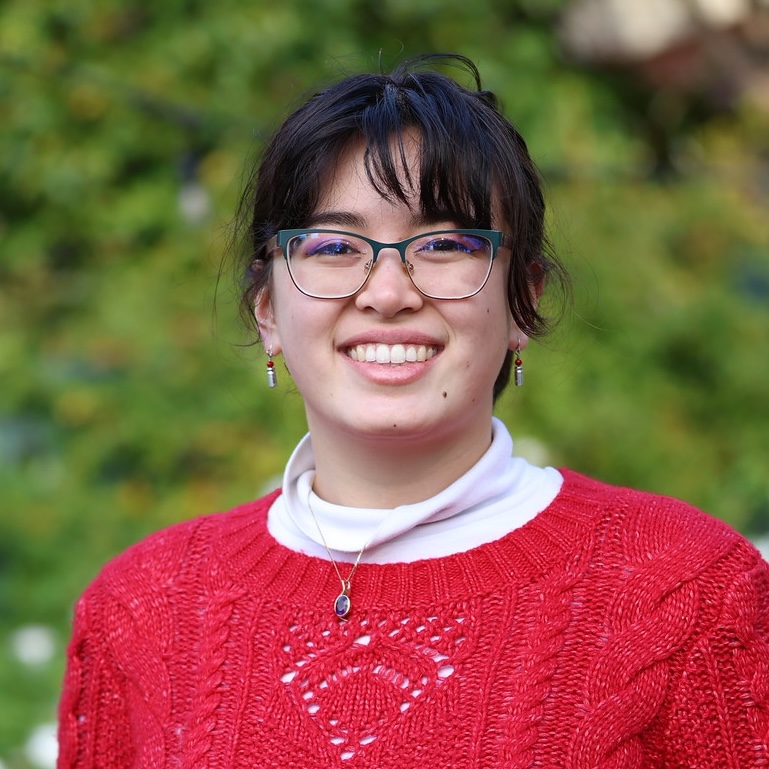
ISE master’s student Elizabeth “Thea” Higgins
Elizabeth Higgins knew she wanted to be an engineer as soon as she learned it was a job. She spent middle and high school on robotics teams in her hometown of Menlo Park, California. By the time she arrived at the University of Washington, she was more curious about the people on the other side of the machine.
“I always knew that I wanted to think about how people will use whatever is being created,” Higgins says.
Higgins earned her bachelor’s degree in ISE and is now in the second year of her master’s. Along the way, she has studied fatigue in medical residents, helped a critical care transport team track blood supplies and collected training data for robots at Meta.
Finding a home in human factors
ISE gave Higgins a path into human factors, the study of how people interact with systems and tools, along with a full grounding in engineering fundamentals. “You can’t tell me I’m not an engineer,” she says, laughing.
Her first ISE course was Human Factors, taught by Associate Professor Ji-Eun Kim. Higgins joined Kim’s Human and Systems Lab the following summer, helping collect eye-tracking and physiological signal data for a study on vigilance among medical residents at Harborview Medical Center. She stayed with the project through her undergraduate years, supported by the National Science Foundation Research Experience for Undergraduates (NSF REU), and Kim encouraged her to continue the work as a master’s student.
“I still remember meeting Elizabeth for the first time in my undergraduate course,” Kim says. “Since then, she has grown into an independent researcher who proposes, develops, and leads her own research ideas.”
Higgins also found community through the UW student chapter of the Human Factors and Ergonomics Society, which Kim advises and where she calls Higgins “a true gem.” As president, she helped launch the ISE Research Cafe last year, a gathering where students and faculty from across the department share their lab work and explain how to get involved.
“As an undergrad, I knew the research that I was doing,” she says. “I had no idea what anyone else who was not on my project was doing, much less anyone else in a different lab.”
Systems are everywhere
Without a formal internship as an undergraduate, Higgins found other ways to practice. She did inventory research for a family friend, reorganized the warehouse of a dog rescue her family fosters for and even restructured her parents’ spice drawer using frameworks from her ISE courses.
“A big advantage of this degree is that it applies to any system,” she says. “And systems are everywhere.”
Her senior capstone put that idea to work. Higgins’ team partnered with Airlift Northwest, which flies critically ill and injured patients to hospitals. Every flight carries transfusable blood that can be out of refrigeration for only 24 hours total, and crews were tracking that time by hand on a sheet of paper taped to the fridge, often estimating and rounding after a rushed departure.
After interviews and surveys with crews, the team ruled out an automatic sensor because flight nurses were unlikely to trust a device that gave them no feedback. They built a prototype app with a simple start-and-stop timer that tracks totals and keeps a history. User testing showed time savings and more accurate records, and the project won first place in the 2025 ISE Capstone Competition.
“We used so much of what we learned in a context where you don’t necessarily think of needing an industrial engineer,” Higgins says. “I think that’s what’s great about this major. You can use your skill set in so many different places.”
Robotics, full circle
Before starting her master’s program, Higgins interned at Seattle Children’s Hospital. There, she saw how process improvement could help a large organization build values like high-quality care into its culture.
This past summer, a recruiter’s LinkedIn message brought her back to robotics and back home. As a robotics data operator at Meta’s Menlo Park headquarters, she worked with a team building physical AI, systems that let robots learn to act in the real world. Higgins operated robots through specified tasks to generate training data, then sorted that data into quality tiers. Meta kept her on, and she continues the work remotely while finishing her degree.
“It reminded me that you can do research outside of academia,” she says.
Back in Kim’s lab, Higgins is developing a project on the mental workload of surgeons learning robot-assisted surgery. This represents a full circle moment for her, since it was Intuitive’s da Vinci Surgical System that served as a major inspiration for pursuing engineering as a career path. Intuitive also once sponsored Higgins’ high school robotics team.
Higgins plans to finish her master’s degree in spring 2027 and hopes to stay in robotics. She’s comfortable that her route hasn’t been a straight line.
“I did a lot of informational interviews in undergrad, and every person I talked to was saying, ‘Oh, I didn’t really have a very traditional path,’” she says. “So I’m happy to be another person with that story.”