
Amy Sprague
May 8, 2026
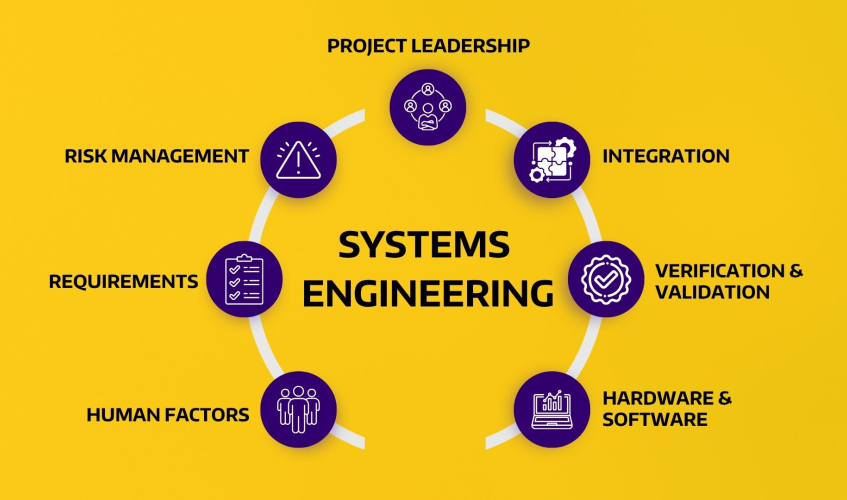
The challenges engineers face today rarely stay neatly within a single discipline. A new aircraft system involves not just aerodynamics but software, supply chains, risk modeling, and teams of people working across borders and time zones. Managing all of that with the whole system in mind is the job of a systems engineer.
The Department of Industrial & Systems Engineering (ISE) is meeting that demand with a suite of professional graduate programs designed for engineers and technical professionals who are already in the field, as well as students ready to build those skills from the start.
The job outlook for systems engineering is strong and growing. As AI, autonomous systems, and large-scale digital infrastructure continue to reshape industry, the demand for engineers who can design, integrate, and manage complex systems is only expected to grow. Systems engineering is not locked into one industry, but is relevant across industries, including manufacturing, healthcare systems, aerospace and defense, logistics and supply chain, and tech and consulting.
Two paths to a master's degree
ISE offers two professional master's degrees, each built around a different kind of learner and career trajectory. Both can be taken fully online or in-person.
The newest addition to ISE's professional portfolio is the Master of Engineering in Leadership & Systems Innovation (MELS), a stackable degree that gives students more flexibility to shape their graduate education around their goals. Students select two of three graduate certificates and complete a capstone project with an industry, nonprofit, or government partner. The result is a master's degree built from expertise and validated through real-world applications, available part-time or full-time, in-person or online.
The Master of Industrial & Systems Engineering (MISE) is a flexible, non-thesis program designed for working professionals who can't step away from their careers to go back to school. Classes are offered in the evenings, in-person or online, and via recorded lectures. The curriculum covers systems engineering design, financial modeling, risk management, strategic project planning, and model-based systems engineering (MBSE), taught by faculty and industry practitioners from organizations including Boeing, Microsoft, Intel, and the U.S. Government.
"The UW ISE program provides a solid grounding in current systems engineering standards and processes. I have actively employed the principles and techniques I learned in this program to my current position, and I'm sure they will enhance my value-added to any position I choose to accept."
— Noah R., MISE student. U.S. Navy
The instructors go out of their way to make sure students understand the material. You can tell everyone involved really cares about the program and the people in it."
— Lukas N., MISE student, Boeing
Three certificates, one program
The three graduate certificates at the heart of the MELS program are also available as standalone credentials, which is a practical option for professionals looking to build targeted, immediately applicable skills.
The Graduate Certificate in Data Analytics for Systems Operations (DASO) prepares engineers to make data-driven decisions in complex operational environments using machine learning, statistical inference, optimization, and simulation.
The Graduate Certificate in Systems Engineering: Design & Analysis (SEDA) focuses on the technical core of systems thinking: requirements development, functional modeling, architecture design, MBSE methods, and supply chain management for complex cyber-physical and socio-technical systems.
The Graduate Certificate in Systems Engineering Leadership (SEL) equips students with the decision-making and management capabilities that technical leaders need — from project performance and financial planning to entrepreneurship and conflict resolution.
"The DASO program helped me see the big picture between my work and the opportunities with gaining these skillsets. Now equipped with skills in data analytics, I am able to apply them towards data-driven solutions that benefit the people I work with on the production line."
— Matthew K., DASO graduate, Manufacturing Engineer, Aerospace
Built for where engineering is headed
What makes these programs particularly valuable in the Pacific Northwest is that it's one of the only formal systems engineering graduate offerings in the region. For companies like Boeing that need engineers who can think and lead at a systems level, ISE is helping fill that gap.
Each certificate can also be stacked with credentials from other UW engineering disciplines to unlock additional degree pathways, including a Master of Science in Artificial Intelligence and Machine Learning for Engineering and a Master of Engineering in Multidisciplinary Engineering.
Whether students pursue a single certificate or a full master's degree, the programs share the same underlying purpose: developing engineers who can hold complexity, lead teams, and make an impact that reaches well beyond their own corner of a project.